Showing posts with label Financial Ratio. Show all posts

Tuesday, November 22, 2011

Guinness Anchor Berhad, GAB - Fundamental Analysis


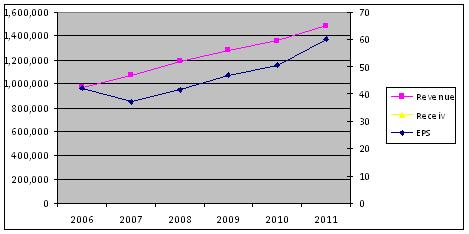
In  GAB The Story, I ended with the remark steady growth but nothing explosive. To illustrate this statement, I charted out the EPS(Earnings per share) and Revenue of GAB from 2006-2011. FYI, financial year end for GAB is 30-June.

So preditable that I can almost draw a straight line into future projection. Notice how the 2008 global financial crisis didn't hamper earnings.

Profit margin at 31% is decent. Carlsberg is at 30-ish% as well.
Operating expenses for SGA (Selling, general & administrative) rose 30% from previous year. At 49% of gross profit, SGA expense is still very alright. Just gotta keep an eye on the yearly increment.

GAB does not need to incur much spending on CAPEX (Capital expenditure). 31 million in 2011, which translate to 17.5% of net earnings. Depreciation is corresspondingly low.

GAB has a cash pile of 178 million and ZERO borrowings.
Due to its zero borrowings, I will not go into gearing ratios. Cos they will be err, zilch.

So, is GAB a cash cow? Lets look at its FCF (free cash flow). Free cash flow is Operating cash flow minus capex. FCF yield in 2011 is 5.36%, an increase of 40% from previous year. Nice.

ROE (Return on Equity) in 2011 is 35%, compared to peer Carlsberg 23% (FY 2010). Take caution when reading into this ratio, as it is affected by the debt level. Highly geared companies can have higher ROE. ROE is meaningful here as GAB has zero gearing.

So far, GAB looks pretty awesome doesn't it? It is obviously a solid and financially sound company. I'd love to own shares of it. But the big question, what is the right price to pay? I should be buying at fair value, or even better, when it is undervalued.

Let's dive into price ratios.
The most popular of all ratios, PE (Price over Earnings) Ratio.
On 22 Nov 2011, PE ratio of GAB is 17.69.
There is only 1 other comparable listed brewery, Carlsberg. PE of 16.67
Growth rate of GAB over 5 years is 7.19%
PEG (PE over growth) ratio is therefore 2.46.
More on PEG, read my previous post PEG Ratio
At the current price of RM10+, GAB is rather overpriced, in my opinion.

What is the fair price for GAB? I use Discounted Cash Flow (DCF) model. But seriously, don't rely too much on it as it has many variables. You know what they say, garbage in, garbage out. I adjust the calculations such as discount factor to my own comfort level. And I am conservative. Throw in all the numbers, and DCF regurgitates RM7.80. That is my number.
There is an excellent tutorial on DCF calculation on Investopedia. Comes with example to guide you through the whole process. If that's too much trouble, there are DCF calculators (usually in spreadsheets) that you can download from the Net.

In summary, I'd buy GAB for the long term, but not at this price. I'm anticipating a recession. Read Macro Outlook 15-Nov-2011. My chance will come.

Wednesday, November 9, 2011

How to pick winning stocks? #1 PEG Ratio

I will write a series on my stock selection criteria, one at a time, in no particular order. #1 criteria does not mean the most important. They are ALL important!
My stock picking techniques are based on fundamental analysis. However, I inspect all 3 aspects of fundamental, technical and macroeconomy before making my buys.

#1 PEG Ratio
Previously, I have discussed about the PE Ratio.

From that discussion, the questions below arose:
Ahat about stocks that have single digit PE? Isn't that a bargain?
And does that hot stock deserve a PE of over 20?

Introducing the 'G' factor into the equation, GROWTH. PEG Ratio is PE over Growth.
PEG ratio of 1 is considered fair.
Less than 1 is undervalued.
More than 1 is overvalued.

Example:-
Using Dutch Lady (DLADY), let's start off with calculating its PE ratio.
Price: RM 20.84
Earnings per share, EPS : RM 0.9982
PE Ratio : Price/EPS
20.84/0.9982
20.87
For simplicity, let's take a round number of PE 21.

Scenario A
Assume DLADY average earnings growth : 21%
PEG ratio : PE/Growth
21/21
1
Thus, the share price of DLADY is deemed FAIR

Scenario B
Assume DLADY average earnings growth : 35%
PEG ratio : PE/Growth
21/35
0.6
Thus, the share price of DLADY is deemed UNDERVALUED

Scenario C
Assume DLADY average earnings growth : 7%
PEG ratio : PE/Growth
21/7
3
Thus, the share price of DLADY is deemed OVERVALUED

Actual Scenario
EPS growth of DLADY since 2007 average out to be 11%.


PEG ratio
: PE/Growth
21/11
1.9


Buy when a share price is FAIR or UNDERVALUE. Translates into PEG Ratio of 1 or less.

Now, about that stock with PE ratio of over 20, say 25. With PEG ratio, we can decide if it is justifiable by check it's earnings growth. If it's growth has been phenomenal, growing at 30% for the past 3 years, that makes its PEG ratio less than 1, UNDERVALUE.

When checking for earnings growth, do look for consistent growth of 3 years or more. A spike in growth in mere 1-2 years isn't too reliable.

Tuesday, November 8, 2011

PE Ratio as I Understand it to be

PE Ratio, P/E, PER & many variations of it means the Price Over Earning Ratio. Price here indicates the Market price. Earning means EPS/Earning per share, which is Nett Profit/Total number of shares. Nett profit taken is yearly, not quarterly.
Example:-
F&N Stock Price : RM 17.24
Earning per share: RM 1.07
PE ratio : Price/EPS 17.24/1.07 16.11
Which means, if you buy the share of F&N, you are willing to pay 16x its yearly earnings.

So, is it alot to pay for? Is it Expensive to buy F&N? The answer depends on several factors. Blue chip stocks usually command for a higher PE. check its P/E for the past 5 years to get a feel of what this stock commands for.
Let's find out.
PE Ratio of F&N at Financial year closing:
2010: 7.4
2009:16.4
2008:19.34
2007:18.76
2006:15.46
*Info from EquitiesTracker.com

Consumer stocks such as F&N deliver steady profits, dividends and growth. Thus, people are generally more willing to pay a higher price for it, driving up the PE.

But what about stocks that have single digit PE? Isn't that a bargain?
And does that hot stock deserve a PE of over 20?
PEG Ratio shall shed some light on this. But that is for discussion on another day.